


When Max Biocare Pty Ltd, wanted to create premium toddler and growing- up formulas and children’s supplements with clinically supported and effective essential ingredients for children’s development and growth, they chose Wellmune® yeast beta glucan for its well-documented immune health benefits. A research-driven, international pharma, nutrition and bioscience company, Max Biocare Pty Ltd creates tailored solutions Continue reading…
Insights, Trends, News, and Research.
Our passion for helping people be well and stay well keeps us dedicated to providing the latest Wellmune® news, market and industry trends, research, and immune health information.

Immune Health and Stress Management: Adapting to Demand for Benefits
In recent years, the link between physical and emotional wellbeing has become more widely recognized; in particular, the connection between stress and sleep and how these can negatively impact overall health. But how? Turns out that the two are intimately intertwined. Immune health can suffer when you’re chronically stressed, and vice-versa. According to the Cleveland Continue reading…

Seen One Beta Glucan, Seen Them All?
You hear a lot now about how beta glucans are great for supporting immune health. And that’s true, but only to a point. It is a generalization, as some beta glucans are shown to support immune health, but not all. The specific source organism (e.g., strain of yeast) of a particular beta glucan makes all Continue reading…
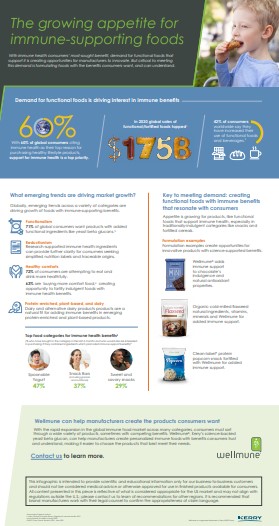
[Infographic] The Growing Appetite for Immune-supporting Foods
Immune health is the top benefit sought by consumers, according to Kerry’s recent global consumer research. What’s more, six in ten global consumers recently surveyed cited immune health as their top reason for purchasing healthy lifestyle products. Key to meeting demand: creating functional foods with immune benefits that resonate with consumers Finding benefits in unexpected Continue reading…

[Infographics] Trends in Regional Immune Health Food Markets
In the last year, global sales of functional/fortified foods topped $175B USD, and four in ten consumers worldwide say they have increased their use of functional foods and beverages. With 60% of global consumers citing immune health as their top reason for purchasing healthy lifestyle products, demand for categories like functional foods with immune health Continue reading…

Top Dietary Supplement Delivery Formats for Immune Health
What are the top dietary supplement delivery formats? Growth in today’s vitamin and dietary supplement market highlights an increase consumer focus on health, wellness and immunity. As proof, Innova reports that immune health was the number one claim in global supplements development in 2020, with 30% of total supplement launches carrying an immune health claim. Continue reading…

How to Create the Best Dietary Supplements for the Immune System
Searches for the best dietary supplements immune health are on the rise, but some scrutiny around dietary supplements is prevalent in mainstream media. Often, the argument is that people consuming a well-rounded diet don’t need dietary intervention from supplements or that supplements don’t actually work. And if they do, they can do more harm than Continue reading…

Making Functional Foods Better: Adding Benefits for Immune Health
In today’s world, sentiment is focused more strongly than ever on proactively preserving health. As awareness of the importance of maintaining both physical and emotional health grows, interest in practices like fitness and nutrition is growing. As a result, nearly two-thirds of global consumers say they have found more ways to tailor their life and Continue reading…
Seen One Beta Glucan, Seen Them All?
You hear a lot now about how beta glucans are great for supporting immune health. And that’s true, but only to a point. It is a generalization, as some beta glucans are shown to support immune health, but not all. The specific source organism (e.g., strain of yeast) of a particular beta glucan makes all Continue reading…

Study Reveals Structural Differences Between Beta Glucans
Research has revealed that immune health ingredient Wellmune® has a unique chemical structure, meaning that the many studies on its benefits cannot be applied to other beta glucans. Multiple biological activities have been attributed to beta glucans, including immunomodulatory effects. However, not all beta glucans affect immune activity, with such benefits depending on their chemical Continue reading…

What Makes a Quality Immune Health Dietary Supplement?
Market trends are reflecting a call for more quality immune health dietary supplements. With six in ten (58%) of global consumers surveyed by Kerry, the makers of Wellmune®, citing immune health as their top reason for purchasing healthy lifestyle products, the concept of ‘food as medicine’ is gaining traction, and is obscuring the boundaries between Continue reading…

Why are the Manufacturing Methods of Beta Glucans so Important?
High-quality beta glucans are supported by a well-developed understanding of an ingredient’s biological activity, its manufacturing processes, and the standardization practices that have been employed to ensure the ingredient is stable and efficacious. Donald Cox, Ph.D., Wellmune’s head of R&D, gives us his firsthand insights into what makes a quality immune health ingredient and why Continue reading…